



Gyuto vs Santoku: Which Japanese Knife Should an Australian Cook Actually Buy First?
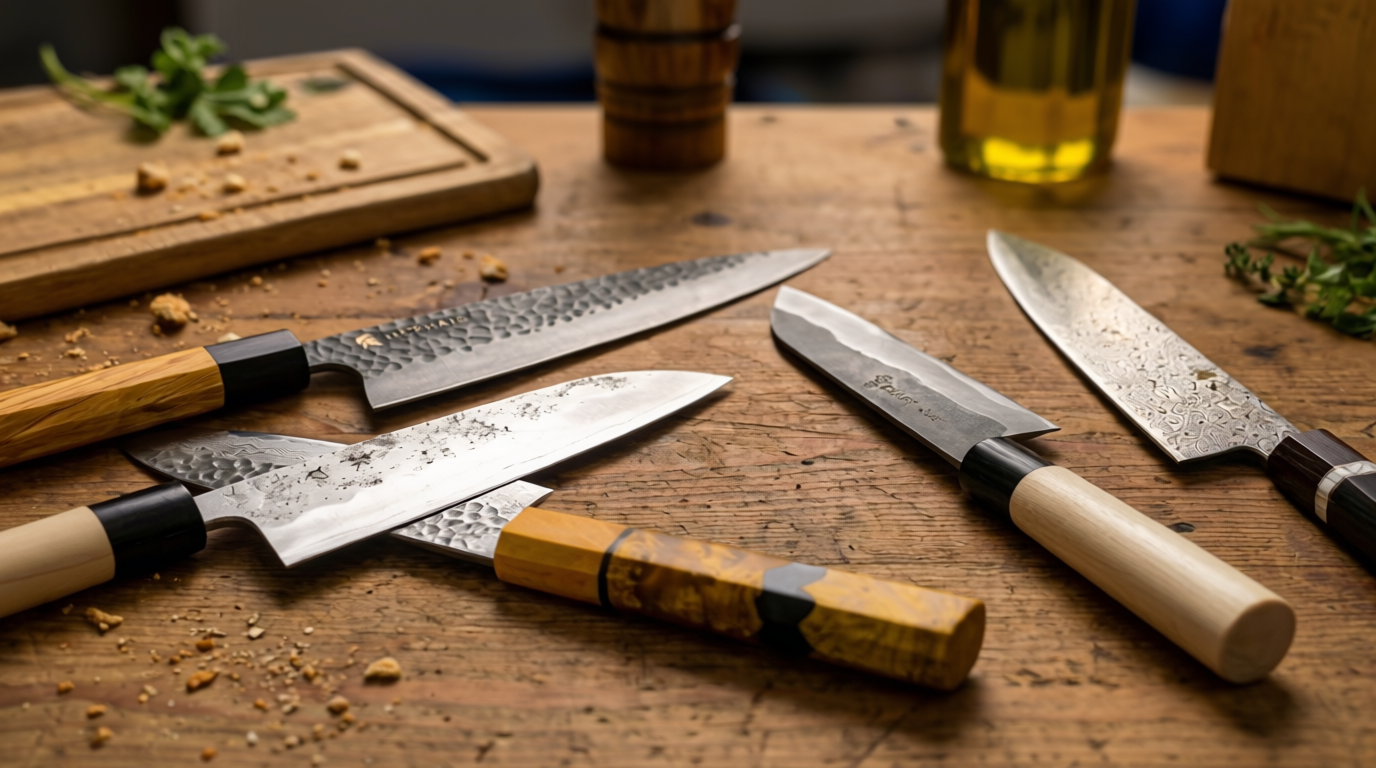
Gyuto and Santoku at a glance: the core differences
When you’re ready for your first serious Japanese knife, the choice almost always comes down to two contenders: the Gyuto and the Santoku. They look similar, but how they feel and perform in your hand is worlds apart. Let’s cut to the chase.
Blade shape and length: why this changes everything
The most obvious difference is the profile. A Santoku typically has a 160mm to 180mm blade with a relatively flat edge and a spine that curves down to meet the tip. It’s a compact, all-purpose design.
The Gyuto, or Japanese chef’s knife, is longer, ranging from 180mm up to 270mm for professional use. Its blade has a more pronounced curve from the heel to its sharp, pointed tip. This length and curve aren’t just for show—they allow for longer slicing strokes and more clearance for your knuckles on the cutting board, increasing your prep speed.
Tip geometry: pointed vs sheep’s-foot and what it means in practice
Look at the tips. The Gyuto’s sharp, pointed tip is a precision tool. It’s perfect for detail work, like scoring vegetables, trimming fat, or making intricate cuts where you anchor the tip to the board.
The Santoku has a ‘sheep’s-foot’ tip, which is less aggressive and more rounded. This design is inherently safer and gives you excellent control for straight-down chopping, but it lacks the Gyuto’s ability to do fine tip-work.
Weight, balance, and how each knife moves in your hand
A Santoku generally feels lighter and more evenly balanced. It’s nimble and easy to manage, making it feel very intuitive for quick, everyday tasks.
A Gyuto is typically more blade-forward, meaning the balance point is further down the steel. This gives it more momentum, allowing the knife’s own weight to help you slice through ingredients with less effort. It feels like a more powerful tool because it is.
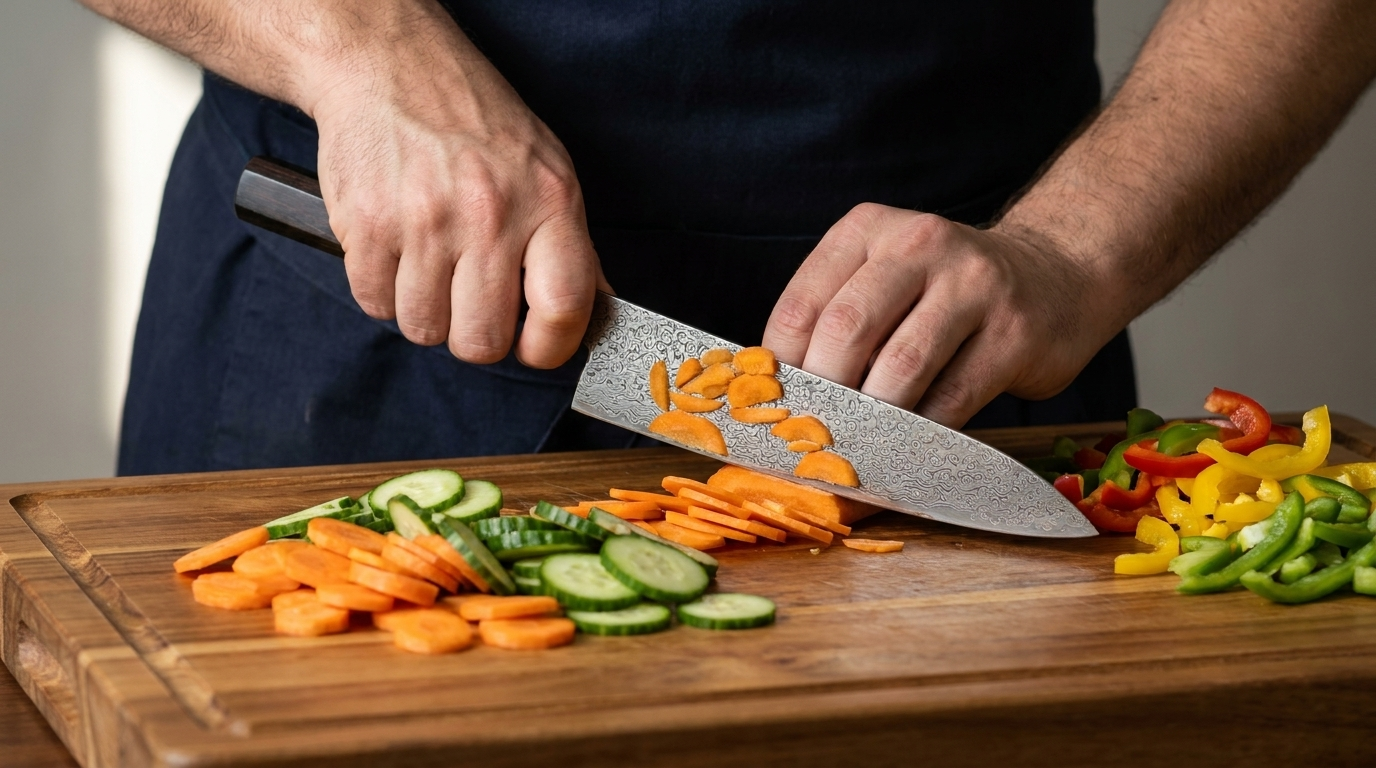
Cutting technique: how each knife wants to move
Understanding a knife’s intended motion is key to unlocking its performance.
The Santoku’s natural motion: straight up-and-down with precision
The Santoku excels at a push-cut or a straight up-and-down chop. Its flatter belly means more of the blade makes contact with the board at the end of each stroke. This is incredibly efficient for dicing onions or breaking down large volumes of vegetables.
The Gyuto’s natural motion: rock-chop, slice, and draw cuts
The Gyuto is more versatile. Its curved belly is made for the classic ‘rock-chop’ motion, where the tip stays in contact with the board as you rock the blade through herbs or garlic. The extra length is also crucial for clean draw-cuts through proteins like fish or steak, ensuring a perfect slice in a single, fluid motion.
Which motion matches how you already cook
Pay attention the next time you use your current knife. If you find yourself doing a lot of up-and-down chopping, a Santoku will feel like a natural upgrade. If you tend to rock the blade or need more length for slicing, the Gyuto is calling your name.
Head-to-head: 5 common Australian kitchen tasks
Let’s put them to the test with ingredients you’re actually using week in, week out.
Vegetables (capsicum, carrot, spring onion): which knife is faster
For dicing dense vegetables like carrots or capsicum, the Santoku’s flat edge and direct chopping motion often feel faster and more controlled. However, for slicing long items like spring onions or leeks, the Gyuto’s length allows you to process more in a single pass. Result: Tie.
Protein (chicken breast, beef, fish fillet): where blade length matters
There’s no contest here. The Gyuto’s longer blade allows you to make a single, clean draw-cut through a chicken breast or a piece of fish. A Santoku often requires multiple smaller cuts, which can tear the protein. For slicing a roast or steak, the Gyuto is the clear winner. Result: Gyuto wins.
Soft herbs and precision garnish: where tip geometry changes the result
When you need to chiffonade basil or finely mince parsley, the Gyuto’s pointed tip gives you the precision the Santoku’s rounded tip just can’t match. You can anchor the tip and make tiny, controlled cuts with ease. Result: Gyuto wins.
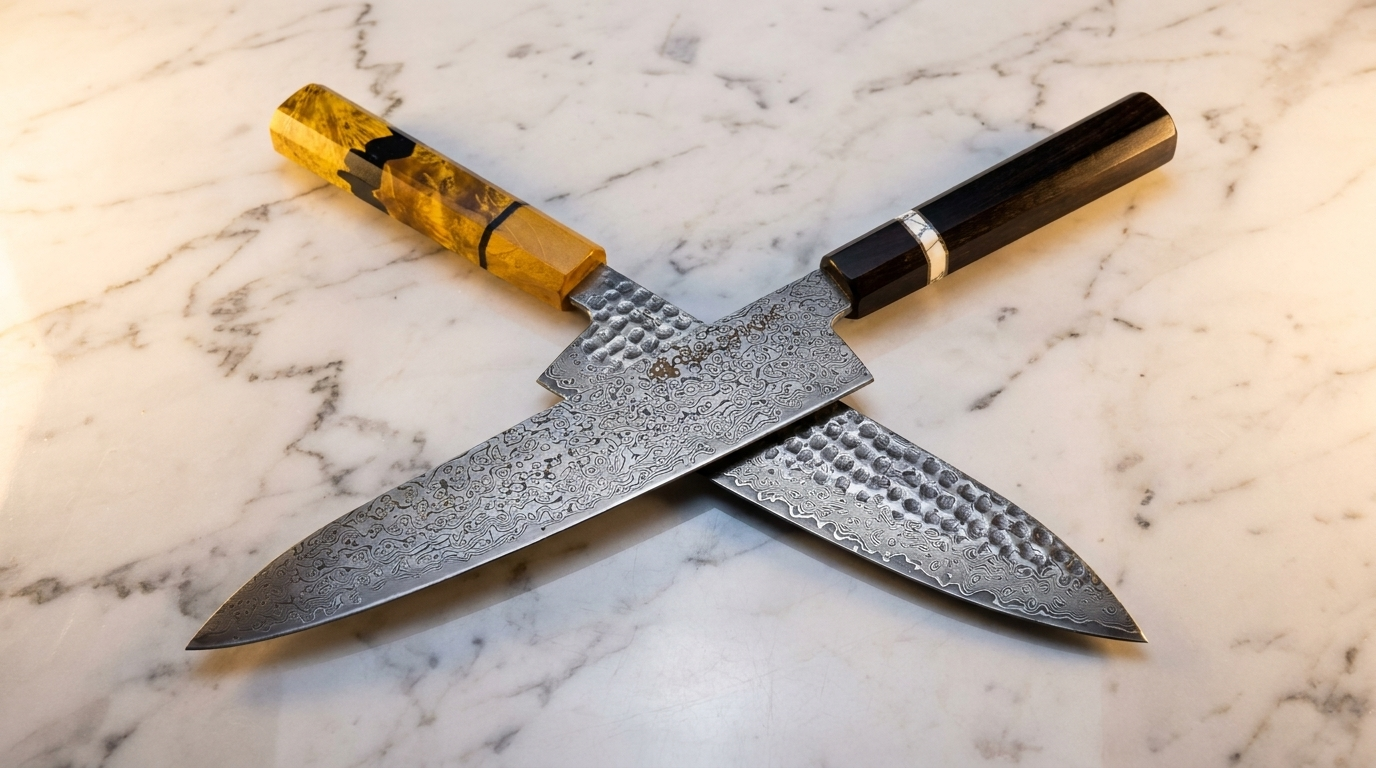
Which knife suits how Australian home cooks actually cook
Your style of cooking is the deciding factor.
If you cook mostly Western and everyday meals
A 210mm Gyuto is the go-to all-rounder for the modern Australian kitchen. It handles everything from prepping vegetables for a weeknight stir-fry to slicing a leg of lamb for a Sunday roast. It’s the most versatile long-term investment.
If you cook a lot of Asian cuisine at home
A 165mm Santoku is a fantastic choice. Its profile is perfectly suited to the up-and-down chopping techniques common in many Asian cuisines for vegetable and noodle dishes. Our collection of Japanese professional knives offers options that excel at this style of cooking.
If you prep for entertaining and dinner parties
Go for a 240mm Gyuto. The extra length and presence make it a high-performance tool for breaking down larger quantities of ingredients and for presentation, like carving a roast at the table. It performs like a professional chef’s tool because it’s designed to be one.
Our verdict: which one should you buy first?
We promised a clear answer, so here it is. Don’t get stuck on “it depends.”
The case for Santoku as your first Japanese knife
The Santoku has an easier learning curve. It feels compact, safe, and immediately capable for everyday tasks. It’s the best choice if you cook 5+ nights a week, have a smaller kitchen, or focus heavily on vegetable-based and Asian dishes.
The case for Gyuto as your first Japanese knife
The Gyuto is the more versatile, professional-standard knife. It has a higher skill ceiling and will grow with you as you tackle more ambitious recipes. It’s the best choice for cooks who want one knife to do it all, especially if you cook a lot of protein.
The one question that makes the decision easy
Ask yourself this: Do you spend more time preparing vegetables or proteins?
If your cooking is 70% or more vegetable-focused, buy the Santoku first. If you have a balanced mix or lean towards proteins and roasts, buy the Gyuto. It’s that simple.
The upgrade moment: when to add the second knife
Eventually, you’ll want both. Here’s how to know it’s time.
Three signs you’ve outgrown your Santoku
You find yourself wishing for a longer blade when slicing a large roast or fish fillet.
You get frustrated by the rounded tip when trying to do fine, precise cuts.
You’re exploring more diverse cuisines and want to master techniques like the rock-chop.
Three signs you actually don’t need a Gyuto at all
Your cooking is 80%+ vegetables, and your Santoku handles it all.
You’ve owned your Santoku for years and have never felt limited by its length.
You cook in a compact kitchen with a small cutting board where a long blade would be clumsy.
What to look for when buying either knife in Australia
When you invest in a quality knife, you’re investing in every meal you’ll make. Look for hard steel like VG-10 with a Rockwell hardness (HRC) of 60+, which holds a sharp 15° edge for longer. Proper maintenance is also key; check out our knife care guide to protect your investment.
In terms of price, you can expect to pay:
Entry-level ($80–$180): Decent steel, but may have thicker blades and less refined finishing.
Mid-range ($180–$350): This is the sweet spot for serious home cooks. You get premium steel, excellent craftsmanship, and a lifetime of performance. The Hephais Aurora Chef Knife and Knox Chef Knife sit right in this range.
Premium ($350+): Often features rare steels, custom handles, and artisanal finishes.


