



Gyuto Knife: The Complete Australian Guide to Japan's Most Versatile Blade
What is a Gyuto knife? (And why it’s not just a Japanese chef’s knife)
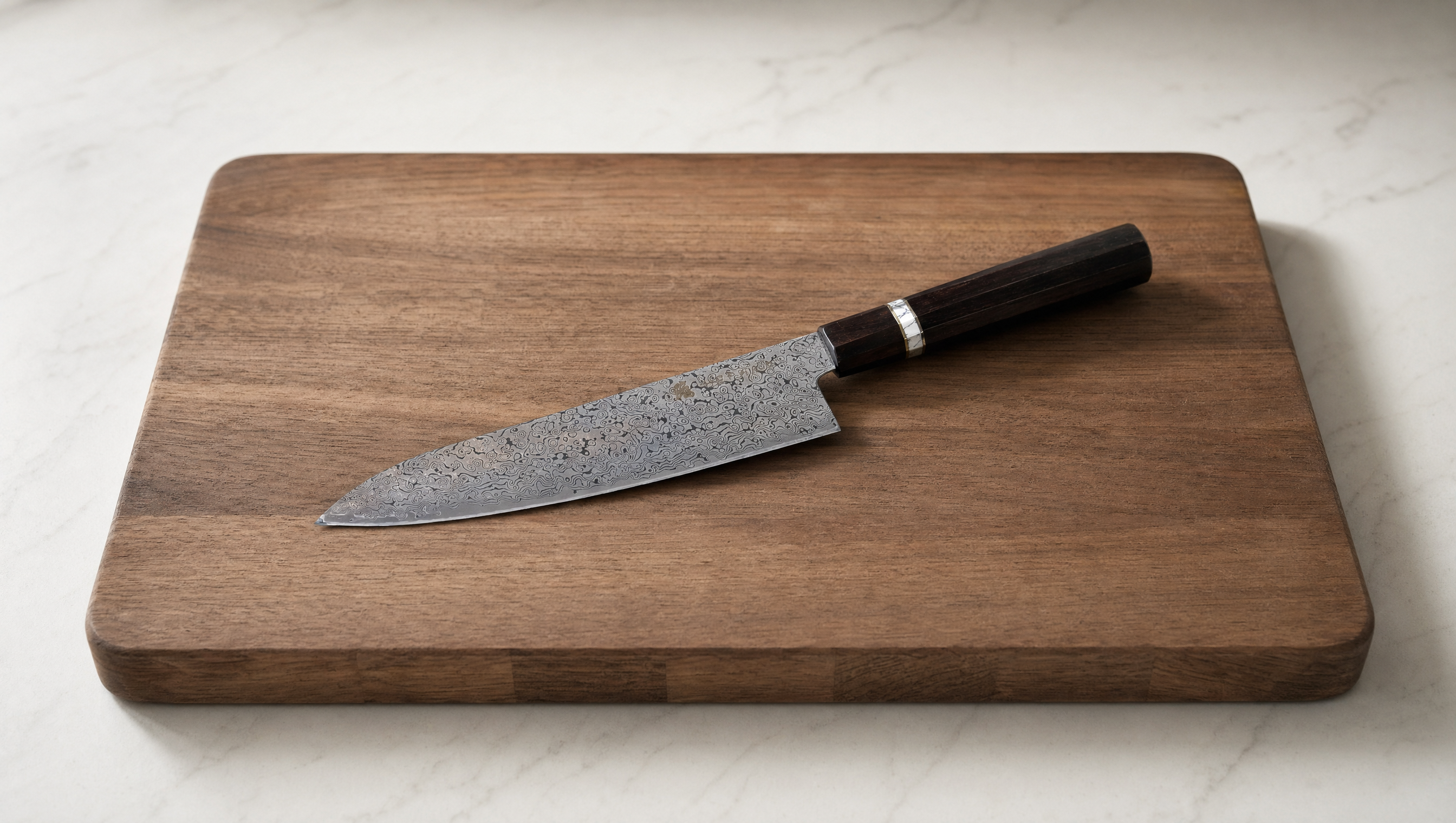
If you think a Gyuto is just a Japanese version of a Western chef’s knife, you’re only seeing part of the picture. The Gyuto is a master of versatility, born from a fusion of cultures, and its unique design makes it arguably the most useful knife you can have in your kitchen.
The etymology: what ‘Gyuto’ actually means
Translated literally, ‘Gyuto’ (牛刀) means “cow sword” or “cow blade.” This name points directly to its origins in Meiji-era Japan. As Western dietary habits—specifically, eating beef—became more popular, Japanese blacksmiths needed a tool to break down large cuts of meat. The Gyuto was their answer.
How the Gyuto evolved from the Western chef’s knife
Japanese smiths took the classic French Sabatier (chef’s knife) as their template but refined it with their own blade-making traditions. They made the blade thinner, used harder steel capable of holding a much sharper edge, and subtly tweaked the geometry. The result was a knife with the length and versatility of a Western chef’s knife but the precision of a Japanese blade.
What makes the Gyuto profile unique: heel, belly, and tip geometry
The genius of the Gyuto is in its profile. It’s a hybrid design that excels at multiple cutting styles:
The Heel: It’s flatter than most Western knives, making it excellent for tap-chopping and push-cutting on a board.
The Belly: It has a gentle curve, allowing for a smooth rock-chopping motion for things like herbs.
The Tip: It’s fine and pointed, giving you incredible precision for detail work, like mincing garlic or shallots.
Which Gyuto size is right for you? (210mm vs 240mm vs 270mm)
Choosing the right length is crucial. It’s not about what’s “best,” but what’s best for you, your space, and your workflow.
210mm: precision work, smaller hands, and tight cutting boards
A 210mm Gyuto is the perfect entry point. It’s nimble, easy to control, and doesn’t feel intimidating. If you’re working in a smaller home kitchen with limited board space, or if you’re transitioning from a shorter Santoku, this size gives you the Gyuto profile without feeling unwieldy.
240mm: the professional standard and why it works for most people
This is the workhorse. A 240mm Gyuto is the standard size in most professional kitchens and for ACF competitions. It has enough length to handle larger vegetables (like cabbage) and portion bigger cuts of meat in a single, clean slice. It offers the perfect balance of power and control, making it the go-to for most cooks. It’s the core of our professional kitchen knives collection.
270mm: when you need the length and how to control it
A 270mm Gyuto is a specialist’s tool. The extra length is fantastic for slicing large roasts, breaking down whole fish, or batch-prepping large quantities of vegetables without interruption. However, it requires more space and a confident technique to control effectively. This is for the experienced chef who needs maximum efficiency.
How to use a Gyuto knife: cutting techniques that match the blade
To get the most out of your Gyuto, you need to match your technique to its unique geometry. It’s not just about chopping up and down.
Push-cutting: the Gyuto’s natural motion
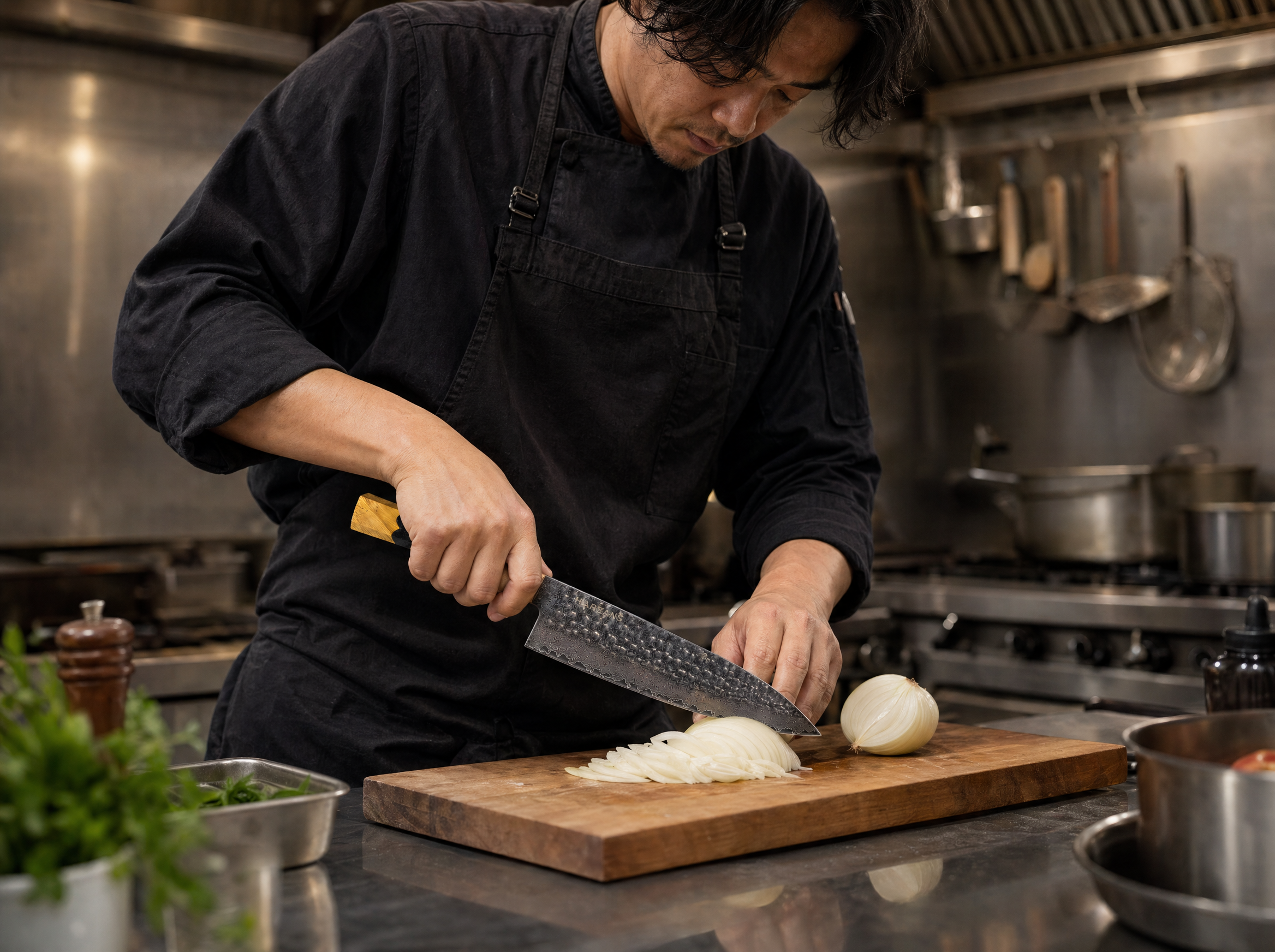
This is the primary technique. Start with the tip of the knife on the board and the food under the middle of the blade. Push the knife forward and down through the ingredient, letting the blade’s sharpness do the work. Your hand moves in a smooth, circular motion. This is far more efficient and precise than a simple vertical chop.
The flat spot: how the heel geometry changes your chop
That flatter section near the heel is perfect for chopping dense vegetables like carrots or potatoes. You can use a firm, confident tap-chop in this zone without needing to rock the blade, giving you stable, uniform cuts.
Tip work and precision slicing: using the curve
For delicate tasks, use the front third of the blade. Anchor the fine tip on the board and use a drawing motion (pulling the knife toward you) to slice through soft herbs or finely mince shallots. For slicing fish for sashimi, you can use the full length of the blade in one long, drawing cut.
What a Gyuto excels at in the Australian kitchen
The Gyuto’s versatility makes it perfectly suited to the modern Australian kitchen, which draws from cuisines all over the world.
Asian ingredients: precision cuts for Vietnamese, Thai, and Japanese cooking
Australia’s love for Asian food makes the Gyuto essential. Its thin, sharp blade makes effortless work of the fine julienne for salads, paper-thin slices of beef for pho, and precise cuts for sushi and sashimi that a thicker Western knife would struggle with.
Meat and poultry prep before the BBQ
Before you fire up the barbie, a 240mm Gyuto is your best friend. It can trim fat caps from brisket, cube lamb for skewers, and slice chicken breasts with unparalleled efficiency and cleanliness. The long blade ensures you get clean, single-motion cuts without tearing the meat.
Fine dining plating cuts: why professional chefs choose the Gyuto
As an official sponsor of the Australian Culinary Federation (ACF), we see firsthand why chefs at the highest level rely on the Gyuto. In competition and fine dining, every cut must be perfect. The Gyuto’s precision tip and fine, sharp edge allow for the delicate tourné cuts, paper-thin vegetable ribbons, and flawless presentation that define professional cooking.
Gyuto knife steel: what to look for and what to avoid
The steel determines the knife’s performance, maintenance, and durability.
VG-10 stainless: the reliable all-rounder
Hardened to around 60–61 HRC, VG-10 is a fantastic Japanese stainless steel that offers a great balance of sharp-edge retention and corrosion resistance. For Australia’s often humid coastal kitchens, its stainless properties make it a practical, low-worry choice for a first Gyuto.
Damascus steel: performance and aesthetics combined
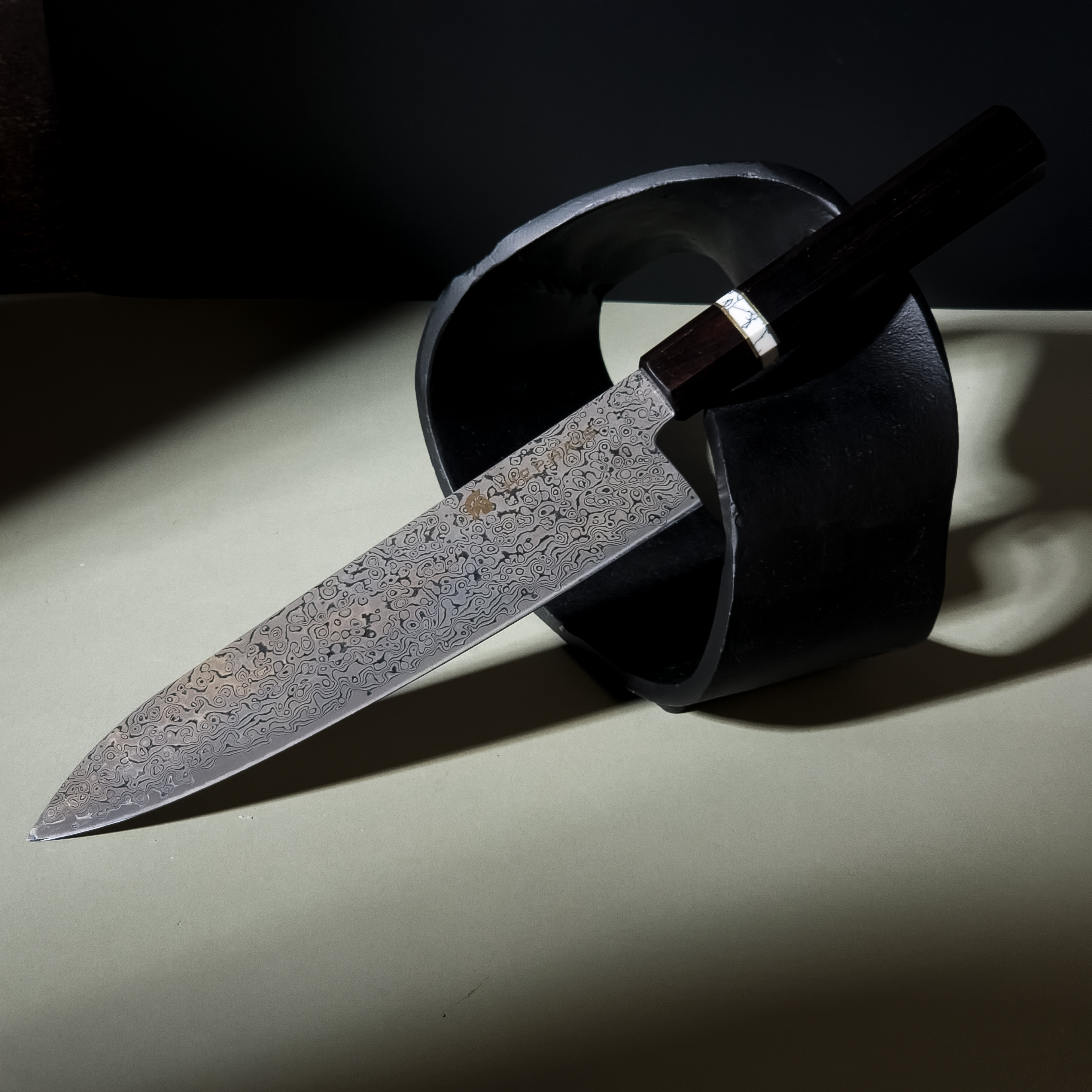
This isn’t just about looks. A Damascus steel knife typically features a hard cutting core (like VG-10) protected by layers of softer, forged steel. This cladding protects the core, adds stain resistance, and helps food release from the side of the blade. It’s high performance married with stunning artistry.
High-carbon steel Gyuto: for experienced knife users only
Steels like Aogami (Blue Paper) and Shirogami (White Paper) can achieve a legendary level of sharpness. However, they are reactive and will rust if not washed, dried, and oiled immediately after use. They demand a strict maintenance routine and are best left to experienced users who value edge-purity above all else.
Buying a Gyuto in Australia: price guide and recommendations
You can find a Gyuto at nearly any price, but quality and performance vary dramatically.
Entry level ($120–$250 AUD)
In this range, look for a knife made in Japan with a VG-10 steel core and a Rockwell hardness of at least 60 HRC. You should get a functional, well-made tool that will serve you well as you learn its capabilities.
Mid-range ($250–$500 AUD): professional kitchen quality
This is the sweet spot for serious home cooks and professional chefs. Here you’ll find knives like the Hephais Aurora Chef Knife and Knox Chef Knife. Designed with real kitchen demands in mind, featuring premium materials and built for daily performance. As an Australian-owned brand and ACF sponsor, we back our knives with a 30-day return policy.
Premium ($500+ AUD): hand-forged and specialist options
These are artisan-made pieces, often hand-forged by a single master blacksmith. The performance gains can be minimal over the mid-range, but you are paying for incredible craftsmanship, unique materials, and a piece of functional art. This is for the collector or the professional who wants the absolute pinnacle of the craft.
Caring for your Gyuto: keeping the edge sharp
A Gyuto is a high-performance tool. A little maintenance will keep it that way.
Honing frequency: more often than you think
Because of its acute angle, a Gyuto’s edge benefits from frequent honing on a ceramic rod. A few gentle swipes before or after each use will realign the microscopic edge, keeping it feeling sharper for longer. Think of it as part of The Rhythm of Maintenance.
Whetstone sharpening for Gyuto-specific angles
Your Gyuto should be sharpened on a whetstone to a fine 15-degree angle per side. A combination stone like a 1000/5000 grit is perfect for maintaining and then polishing the edge to a refined finish. Never use a pull-through sharpener.
Storage: why the wrong block ruins a Gyuto edge
Traditional knife blocks with vertical slots will dull your blade every time you insert or remove it. The best options are a magnetic knife strip (which also shows off your beautiful knife) or a wooden sheath called a ‘saya’.


